This guide cuts through the noise. Whether you're evaluating your first MSP or reconsidering your current provider, you'll find clear profiles of five top managed IT service providers, the criteria that separate good from great, and a practical framework for making the right call.
Key Takeaways
- MSPs remotely manage your IT infrastructure, security, and support under a predictable monthly agreement
- The best providers catch problems before they cause downtime — not after the fact
- Evaluate providers on service breadth, cybersecurity integration, SLA transparency, and whether support is local or offshore
- Local and regional MSPs often deliver faster response times and better business context than national firms
- This guide profiles five providers — including The Local Guy, Dataprise, Ntiva, Corsica Technologies, and Cortavo
What Are Managed IT Service Providers?
A managed IT service provider (MSP) is a third-party company that remotely manages a business's IT systems, end-user support, and security infrastructure — typically under a recurring service agreement with defined SLAs.
What MSPs Actually Do
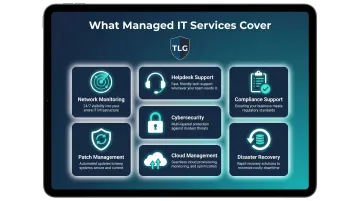
Day-to-day MSP responsibilities typically include:
- Network monitoring — continuous visibility into system health and threats
- Patch management — keeping software and firmware updated to close vulnerabilities
- Helpdesk support — resolving user issues quickly via phone, chat, or remote access
- Cybersecurity — endpoint protection, threat detection, and incident response
- Cloud management — hosting, migrations, and ongoing platform optimization
- Compliance support — helping regulated industries (healthcare, dental, finance) meet requirements
- Disaster recovery — backup systems and tested restore procedures
For many small businesses, an MSP replaces the need for a full-time IT hire. For larger companies, it supplements an existing internal team — a model called co-managed IT.
A Fast-Growing Market
According to Grand View Research, the global managed services market is valued at $401.15 billion in 2025, projected to reach $847 billion by 2033 at a 9.9% CAGR. With over 100,000 MSPs actively operating in the U.S. alone, the challenge isn't finding a provider — it's finding the right one.
Top Managed IT Service Providers
The providers below were evaluated across five criteria: reliability, service depth, cybersecurity posture, pricing transparency, and fit for small to mid-sized businesses. Use the table in each entry to quickly compare services and identify the best match for your situation.
The Local Guy
Utah-based and locally operated, The Local Guy has been serving small and mid-sized businesses across the Greater Utah area for over 35 years. Their mission is straightforward: simplify technology so Utah businesses can focus on growth. They currently manage IT for over 100 companies across the state, with specialized expertise in dental IT compliance and high-security network design.
What sets them apart: Unlike national MSPs that rely on offshore helpdesks or long call queues, The Local Guy is staffed by technicians based right in the Salt Lake Valley. Their 24/7 proactive monitoring watches every workstation, server, and mobile device, catching threats before they become outages.
For dental practices specifically, they provide compliance-focused IT management built around the sensitivity of patient data and the regulatory environment surrounding it.
| Category | Details |
|---|---|
| Key Services | Managed IT support, cybersecurity, cloud hosting, Microsoft 365 setup, 24/7 proactive monitoring, dental IT compliance, network design |
| Best For | Small and mid-sized Utah businesses, dental practices, and local startups needing personalized IT management |
| Notable Differentiator | 35+ years of local Utah IT experience with valley-based technicians, fast response times, and custom-tailored solutions |
Dataprise
Founded in 1995 and headquartered in Rockville, MD, Dataprise is a nationally recognized MSP serving mid-market businesses and strategic IT leaders across the U.S. They were named to the CRN MSP 500 Elite 150 for 2026 and hold a 4.8/5 rating on Clutch from 31 verified reviews.
What sets them apart: Dataprise operates as a single point of accountability for IT operations, cybersecurity, and cloud infrastructure. Their co-managed IT model works well for companies with existing IT staff who need additional depth, security maturity, or 24/7 coverage without replacing their internal team.
| Category | Details |
|---|---|
| Key Services | Co-managed IT, managed cybersecurity, cloud & infrastructure, DRaaS, 24/7 service desk, mobility management |
| Best For | Mid-sized businesses with existing IT staff seeking enterprise-grade security and co-managed flexibility |
| Notable Differentiator | Unified visibility model; SOC 2 Type 2 certified; strong co-managed IT framework |
Ntiva
Headquartered in McLean, VA, Ntiva operates nationwide with a local pod delivery model: dedicated teams assigned to specific clients, backed by national infrastructure. They've earned back-to-back placement on the CRN MSP 500 Elite 150 (2026) and are recognized on both Clutch and G2.
What sets them apart: Ntiva is built for fast-growing SMBs that need IT strategy, not just IT support. Their Virtual CIO (vCIO) service gives businesses access to C-level IT leadership without the full-time cost, helping growing companies align technology decisions with business objectives. The local pod model means clients get technicians who know their environment, while the national network provides redundancy and depth.
| Category | Details |
|---|---|
| Key Services | 24/7 helpdesk, managed cybersecurity, cloud solutions, vCIO consulting, vCISO, compliance support, network management |
| Best For | Fast-growing SMBs that need scalable IT and strategic guidance to support expansion |
| Notable Differentiator | Local pod model combined with national scale; dedicated vCIO service for IT-business alignment |
Corsica Technologies
USA-based with 24/7/365 U.S.-based support, Corsica Technologies targets SMBs through mid-enterprise clients, particularly in regulated industries. They've earned multiple 2026 recognitions including G2 High Performer and CloudTango MSP US Select, plus a multi-year streak on the CRN Solution Provider 500.
What sets them apart: Most MSPs outsource parts of their security stack. Corsica doesn't. Their in-house SOC, MDR, and SIEM capabilities mean security monitoring and incident response are handled internally, with no third-party gaps. Their "Corsica Secure Plan" bundles managed IT and cybersecurity into a single all-inclusive monthly price, backed by a formal Cybersecurity Service Guarantee — a commitment that's rare in the market.
| Category | Details |
|---|---|
| Key Services | Managed IT, managed cybersecurity, cloud services, compliance (HIPAA, CMMC, NIST), vCISO, data integration, EDI, AI consulting |
| Best For | Mid-market businesses in regulated industries that want a single IT + security partner with no outsourcing |
| Notable Differentiator | In-house SOC/MDR/SIEM; all-inclusive bundled pricing; formal cybersecurity service guarantee |
Cortavo
Founded in 2019 and headquartered in Atlanta, GA, Cortavo was built specifically around SMB budget predictability. Their model eliminates vendor sprawl by bundling hardware, software, helpdesk, cybersecurity, and connectivity into a flat monthly fee. They were named a Clutch Top MSP in Atlanta for 2025.
What sets them apart: Cortavo's three-tier plan structure (Productivity, Connectivity, Techtility) lets small businesses choose coverage without managing multiple vendor relationships. The Techtility plan includes desktops, laptops, and monitors, converting hardware from a capital expense to a predictable operating cost. For SMBs that have dealt with unpredictable IT bills, this all-in model delivers meaningful financial clarity.
| Category | Details |
|---|---|
| Key Services | 24/7 helpdesk, cybersecurity, hardware procurement (Techtility plan), connectivity management, cloud services |
| Best For | SMBs that want a single vendor, all-inclusive IT solution with hardware included and no surprise costs |
| Notable Differentiator | Flat-fee bundled model with hardware included; CAPEX-to-OPEX conversion; single-vendor simplicity |
How We Chose the Best Managed IT Service Providers
Providers were assessed on service breadth, cybersecurity integration, SLA transparency, client reputation, scalability, and business fit — not brand recognition or marketing spend. The goal was to surface MSPs that actually deliver day-to-day, not just ones that present well in a sales call.
What Actually Separates Good from Great
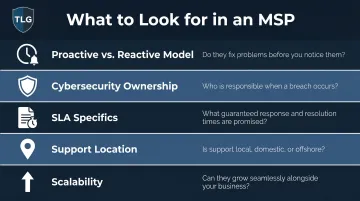
The most common mistake businesses make when selecting an MSP is choosing on price alone, then discovering that response time standards, cybersecurity scope, and service exclusions were buried in the contract. Here's what to scrutinize:
- Proactive vs. reactive model: Does the MSP catch issues before they escalate, or do they wait for your call?
- Cybersecurity ownership: Is security bundled into the core plan, or treated as an upsell?
- SLA specifics: What are the guaranteed response and resolution times for different severity levels?
- Support location: Who actually picks up the phone — a knowledgeable local technician or a tiered call center?
- Scalability: Can the MSP grow with you, or will you outgrow their capabilities within 18 months?
Why Industry Experience Matters
The criteria above reveal a lot about an MSP's capabilities — but they don't tell you whether the provider actually understands your business. A generic MSP applies the same approach to every client. One with vertical experience in healthcare, dental, finance, or legal already understands your compliance requirements, your workflow demands, and the specific risks your industry faces.
According to IBM's 2025 Cost of a Data Breach Report, the global average cost of a data breach now sits at $4.4 million. For a dental practice or financial services firm, a breach doesn't just mean recovery costs — it means regulatory exposure and reputational damage. An MSP that understands your vertical can design controls around those risks from day one, not patch them in after the fact.
Conclusion
Selecting an MSP is a strategic business decision. The right partner reduces downtime, tightens your defenses against threats, and frees you to focus on growth instead of troubleshooting tech problems at 7 PM.
Go beyond the sales pitch. Ask for SLA documentation upfront. Understand their onboarding process. Confirm whether cybersecurity is genuinely integrated or sold as a separate add-on. Check verified reviews on Clutch or G2, not just the testimonials on their homepage.
For Utah businesses specifically, local support matters more than most businesses realize. Fast response times, technicians who already know your environment, and a team rooted in the same community — these advantages show up in real ways: quicker resolutions, fewer disruptions, and a partner who's accountable beyond the contract.
The Local Guy has been providing trusted IT support to small and mid-sized businesses across Utah for over 35 years. Reach out at (801) 386-9491 or support@thelocalguy.com to talk through how they can simplify your IT.
Frequently Asked Questions
What are managed IT service providers?
MSPs are third-party companies that remotely manage a business's IT infrastructure, systems, and support under a recurring service agreement. Coverage typically includes monitoring, helpdesk, cybersecurity, cloud management, and compliance support — functioning as an outsourced IT department.
How much should managed IT services cost?
Typical SMB pricing ranges from $150 to $400 per user per month, depending on service scope and cybersecurity depth. Per-device pricing runs $50–$100 per workstation and $100–$400 per server. Flat-fee models are also common, particularly for all-inclusive plans.
What services should be included in a managed IT plan?
A solid plan includes 24/7 monitoring, helpdesk support, patch management, cybersecurity (endpoint protection + threat detection), cloud management, data backup, and disaster recovery. Any plan that treats cybersecurity as an optional add-on is worth questioning — security should be baseline, not an upsell.
What is the difference between managed IT services and break-fix IT support?
Break-fix is reactive: you pay when something breaks. Managed IT is proactive — the MSP monitors your systems continuously and resolves issues before they cause downtime. The result is predictable monthly costs instead of unpredictable emergency bills.
How do I know if my business needs a managed IT service provider?
Key signals include: frequent downtime or tech disruptions, no in-house IT expertise, growing cybersecurity concerns, difficulty keeping up with software updates and compliance, or the need to scale IT capacity without adding headcount.
Can a managed IT service provider work alongside my existing internal IT team?
Yes — this is called co-managed IT. The MSP handles specific functions like 24/7 monitoring, cybersecurity, or cloud management while your internal team manages day-to-day user support. It's a flexible model that extends your team's capabilities without replacing them.