Introduction
Running a small business means wearing a lot of hats. But "IT manager" shouldn't be one of them — especially when a single network outage or security breach can bring operations to a halt.
Most small businesses don't have a dedicated IT department. They rely on whoever's most tech-savvy in the office, call someone when things break, and hope nothing goes seriously wrong in between. That approach works until it doesn't.
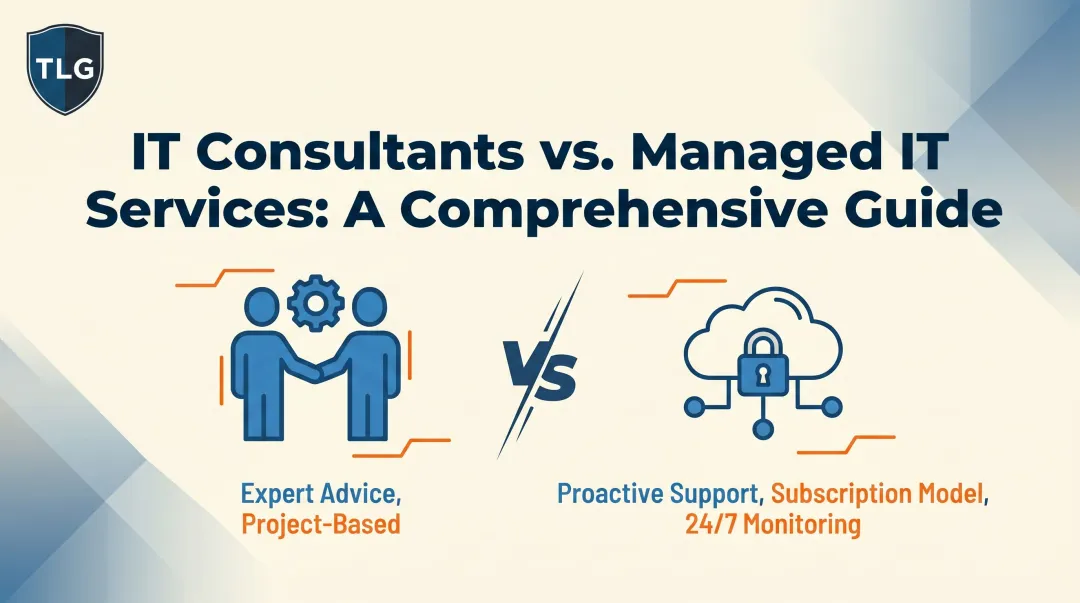
Managed IT services flip this model. Instead of reacting to problems after they've already cost you time and money, you partner with a managed service provider (MSP) that monitors, maintains, and secures your technology around the clock — for a predictable monthly cost.
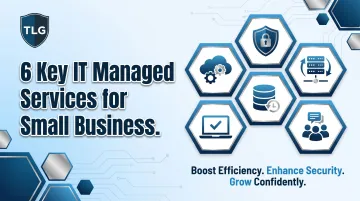
This post covers the 6 managed IT services every small business should have in place:
- Network monitoring
- Cybersecurity
- Data backup and disaster recovery
- Help desk support
- Cloud services management
- IT strategy consulting
Each one targets a real operational risk. Together, they keep your business running — and out of crisis mode.
Key Takeaways
- Managed IT services give small businesses enterprise-level tech support without hiring an in-house team
- The 6 key services: network monitoring, cybersecurity, data backup/disaster recovery, help desk support, cloud management, and vCIO consulting
- Proactive IT management stops downtime and security breaches before they disrupt operations
- MSPs deliver predictable monthly costs and a planned IT strategy
- Look for local expertise, documented SLAs, and compliance knowledge specific to your industry
What Are Managed IT Services (and Why Small Businesses Need Them)?
Managed IT services means outsourcing your technology operations to a third-party provider who monitors, maintains, and supports your systems for a flat monthly fee. No surprise invoices, no scrambling for help after something breaks.
The alternative — break-fix IT — is exactly what it sounds like. You pay someone to fix things after they break. The problems with this model are predictable:
- Higher per-incident costs with no ceiling
- Longer downtime while you scramble to find help
- Zero proactive security or maintenance
- No visibility into what's coming next
Managed services shift IT from reactive to preventive. Your provider is watching your systems before anything goes wrong — patching vulnerabilities, catching anomalies, and resolving small issues before they become expensive ones.
Those benefits add up fast, and the numbers bear it out. According to Grand View Research, the global managed services market is projected to grow from $401 billion in 2025 to $847 billion by 2033. Small businesses are a major driver of that growth — not because managed IT is a luxury, but because it's become a baseline requirement.
The 6 Key IT Managed Services for Small Business
Not every IT service delivers equal value for a limited budget. These six areas give small businesses the highest protection and the clearest return on investment.
1. Network Monitoring & Management
Your network is the backbone of your business. If it's slow, unstable, or compromised, everything suffers — from your ability to process payments to your team's ability to communicate with customers.
24/7 network monitoring means a provider is watching your servers, routers, workstations, and traffic patterns continuously. When something looks off — unusual traffic spikes, unauthorized access attempts, a server running hot — the team responds before it escalates.
Proactive patch management is part of this too. Unpatched software is one of the most common entry points for attackers. A managed provider ensures updates are applied systematically, not whenever someone remembers.
Business impact:
- Fewer unexpected outages disrupting operations
- Faster issue resolution (problems caught in minutes, not hours)
- Protection that operates outside business hours, when no one else is watching
The Local Guy's monitoring runs around the clock, specifically designed to catch small issues before they become expensive downtime — and to stop threats while clients are focused on running their businesses.
2. Cybersecurity Services
Small businesses are not off the radar for cybercriminals. As larger organizations harden their defenses, attackers increasingly shift focus to smaller targets with fewer protections in place. The Verizon Data Breach Investigations Report consistently identifies social engineering and credential misuse as leading breach patterns — tactics that work especially well against organizations without dedicated security staff.
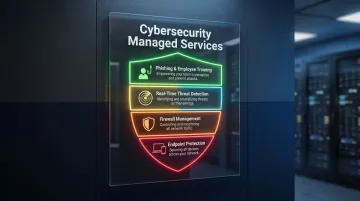
A comprehensive cybersecurity managed service typically includes:
- Endpoint protection — securing every laptop, phone, and server on your network
- Firewall management — monitoring and maintaining the perimeter of your network
- Real-time threat detection — continuous monitoring to catch and contain threats as they emerge
- Phishing and employee training — because your team is often the first line of defense
For businesses in regulated industries, cybersecurity and compliance are inseparable. HIPAA violations, for example, carry civil penalties ranging from a few hundred to over $2 million per violation — a risk no small practice can absorb.
The Local Guy has specialized experience in dental IT compliance, helping practices implement the security controls and monitoring needed to meet HIPAA requirements without building that expertise in-house.
3. Data Backup & Disaster Recovery
Backing up your data and having a disaster recovery plan are not the same thing. Many businesses do the former but skip the latter — and discover the difference at the worst possible moment.
A true disaster recovery service includes:
- Automated, off-site or cloud backups running on a defined schedule
- Tested recovery procedures — not just a backup file sitting on a drive somewhere
- Defined recovery time objectives (RTOs) so you know how long restoration takes
- A plan for multiple scenarios: ransomware, hardware failure, natural disaster, human error
The gap between what businesses think they have and what they actually have is significant. A Nationwide survey found that 68% of small business owners had no written disaster recovery plan. Without one, a ransomware attack or server failure doesn't just mean lost data — it can mean lost business.
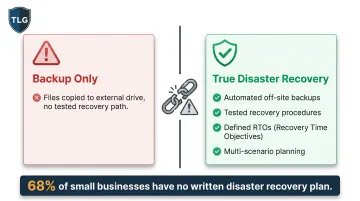
If your backup strategy amounts to "we copy files to an external drive occasionally," you have no tested recovery path — and no guarantee you can restore operations when it counts.
4. Help Desk & End-User Support
When an employee can't log in, can't connect to a shared drive, or has a software issue freezing their workflow, every minute they spend troubleshooting is a minute they're not doing their job.
Managed help desk support gives your team a direct line to real technical assistance — fast. No Googling for answers, no pulling the business owner away from higher-value work, no waiting until "the IT guy" can come by.
The cost comparison alone makes this worth considering. According to the U.S. Bureau of Labor Statistics, the median annual wage for a computer support specialist is $61,550 — and that's before benefits, training, and turnover costs. An MSP agreement typically provides access to a full team of specialists for a fraction of that.
What good help desk support looks like:
- Multiple contact channels (phone, email)
- Fast response times with no lengthy callback queues
- Local technicians who understand your systems and history
- Proactive outreach when a known issue is trending
The Local Guy specifically emphasizes support that actually picks up the phone — technicians in South Salt Lake, ready to respond without the runaround.
5. Cloud Services Management
Most small businesses are already using some form of cloud services — Microsoft 365, cloud storage, remote access tools. The question is whether those services are configured correctly, cost-efficiently, and securely.
Managed cloud services cover the full lifecycle:
- Migration from on-premise systems to cloud platforms
- Ongoing management of Microsoft 365, cloud storage, and hosted applications
- Security configuration to ensure cloud environments aren't accidentally left open
- Scalability support — adding users, storage, or capabilities as the business grows
The scalability factor matters most for small businesses. Cloud infrastructure lets you grow without proportional hardware investment — adding five employees doesn't mean buying five new servers.
The Local Guy handles Microsoft 365 setup and migration — Teams, SharePoint, and the full suite — along with cloud hosting that keeps business applications accessible from any device. That means no on-site server room to maintain and no infrastructure headaches when the team grows.
6. IT Strategy & Consulting (vCIO)
Without someone thinking strategically about technology, most small businesses make IT decisions reactively. A server dies and gets replaced. Software falls behind. Security gaps go unaddressed until a breach forces the issue.
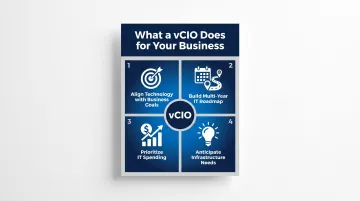
A virtual CIO (vCIO) is a fractional IT leader who works alongside the business owner to:
- Align technology decisions with business goals
- Build a multi-year technology roadmap
- Prioritize IT spending where it creates real value
- Anticipate infrastructure needs before they become emergencies
This service matters most for businesses in growth mode — or businesses that have been making ad hoc technology decisions for years and want to clean up the mess. A vCIO turns IT from a cost center into a planning function.
The Local Guy offers Practical IT Consulting, looking at current systems and recommending upgrades that make sense for long-term growth — not just whatever fixes the immediate problem.
How to Choose the Right Managed IT Provider
The difference between a good MSP and a frustrating one often comes down to a few key factors. Before signing anything, ask these questions:
On service depth:
- Do they offer proactive monitoring, or is support reactive?
- What's included in the base agreement versus charged as extras?
- Do they have experience with businesses your size and in your industry?
On accountability:
- Are response times and uptime commitments documented in a Service Level Agreement?
- What happens if they miss those commitments?
On compliance:
- If you operate in a regulated industry (healthcare, dental, legal, financial), do they understand your compliance requirements — not just IT in general?
The most common mistake small businesses make is choosing based on lowest price alone. A cheap provider that can't respond quickly, doesn't understand HIPAA, or lacks local availability can cost far more in downtime and exposure than the money saved monthly.
That's where local providers have a practical edge. They can show up on-site when remote troubleshooting stalls, they know the regional business environment, and they tend to treat clients as long-term relationships rather than support tickets.
Conclusion
The six managed IT services covered here — network monitoring, cybersecurity, data backup and disaster recovery, help desk support, cloud management, and IT strategy consulting — aren't optional extras. They're the operational foundation every small business needs to stay secure, keep running, and grow with confidence.
Managed IT prevents the downtime, data loss, and security incidents that derail businesses and drain resources. Small businesses that treat IT proactively — rather than reactively — spend less time recovering from problems and more time focused on growth.
The Local Guy has been helping Utah small businesses simplify their technology for over 35 years. Whether you need to lock down your cybersecurity, move to the cloud, build a strategic IT roadmap, or just have someone reliable to call when something goes wrong, reach out for a consultation at (801) 386-9491 or support@thelocalguy.com.
Frequently Asked Questions
What is the difference between managed IT services and break-fix IT support?
Break-fix IT is reactive — you call for help after something fails and pay per incident. Managed IT is proactive — your provider monitors and maintains systems continuously for a flat monthly fee. The result is fewer outages, faster resolution when issues do occur, and predictable costs.
How much do managed IT services typically cost for a small business?
Pricing varies by the number of users, devices, and services included, but most small businesses pay a per-user or per-device monthly fee. In most cases, this costs far less than hiring a single in-house IT employee — and you get a full team of specialists rather than one generalist.
Do small businesses really need managed IT services, or is it only for larger companies?
Managed IT is especially valuable for small businesses, which often lack the in-house resources to handle cybersecurity, compliance, and infrastructure. Small organizations are also prime cyberattack targets — attackers know they're less defended than larger enterprises.
How does a managed IT provider help with cybersecurity?
A qualified MSP provides endpoint monitoring, firewall management, patch management, phishing training, and real-time threat detection — the core controls that keep breaches from halting your operations or exposing customer data.
What should I look for in a managed IT service provider?
Prioritize: documented SLAs with clear response times, experience with businesses your size and industry (especially if compliance matters), local availability for on-site support, and transparent flat-rate pricing with no hidden fees.
Can a managed IT provider help my business with compliance requirements?
Yes. A qualified MSP can help businesses — including dental practices and healthcare providers — meet HIPAA and other regulatory requirements by implementing the right security controls, maintaining documentation, and providing continuous monitoring that satisfies compliance standards.