Introduction
Utah IT vendors toss around "IT consultant" and "managed IT services" like they mean the same thing. They don't—and picking the wrong model can leave you paying for expertise you don't need, or exposed to risks that never get addressed.
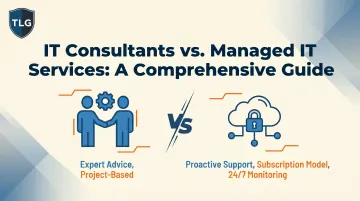
The practical difference comes down to scope and duration. IT consulting is built for focused, time-limited projects: a compliance audit, a network redesign, or a one-time cloud migration. Managed IT services are built for everything else—the day-to-day monitoring, security, patching, and support that keeps your business running whether or not anything goes wrong.
Choosing the wrong model means you'll either overpay for project work you don't need, or go without the ongoing coverage that prevents downtime and security gaps from compounding. This guide breaks down both models and helps you figure out which one fits where your business is right now.
Key Takeaways
- IT consultants are project-based specialists hired for defined challenges—migrations, compliance audits, network design
- Managed IT service providers (MSPs) take ongoing responsibility for monitoring, securing, and maintaining your entire IT environment
- Consulting is billed hourly or per project; managed services use a predictable monthly fee
- Businesses without internal IT staff usually benefit most from managed services; those planning a major tech change often start with consulting
- Many businesses use both: consulting for a specific transition, then managed services for ongoing stability afterward
IT Consultants vs. Managed IT Services: Quick Comparison
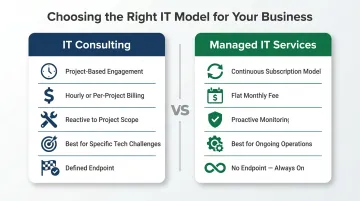
Here's a side-by-side breakdown of how IT consulting and managed IT services compare across the dimensions that matter most to small business owners:
| Dimension | IT Consulting | Managed IT Services |
|---|---|---|
| Primary Focus | Strategy, assessment, project execution | Ongoing operations, security, and uptime |
| Engagement Type | Project-based, defined endpoint | Subscription-based, continuous |
| Typical Services | Compliance audits, migrations, roadmaps, network design | 24/7 monitoring, helpdesk, patching, backup, cybersecurity |
| Cost Model | Hourly or per-project | Flat monthly fee |
| Response Mode | Reactive to project scope | Proactive—catches issues before they escalate |
| Best Suited For | Businesses planning specific tech changes | Businesses needing consistent, ongoing IT coverage |
One important note: this table reflects typical arrangements. Many providers, including The Local Guy here in Utah, offer hybrid models where consulting and managed services are available under one relationship. That flexibility matters when your needs shift over time.
What Is an IT Consultant?
An IT consultant is a specialist—or firm—brought in for a defined period to tackle a specific technology challenge. The engagement is advisory and project-based, not operational. They assess, plan, and often oversee implementation before the engagement closes.
What IT Consultants Typically Do
For small and mid-sized businesses, common consulting engagements include:
- Infrastructure assessments — evaluating whether your current setup can support business growth
- Cloud migration planning — scoping the move from on-premise systems to cloud-based platforms
- Cybersecurity policy reviews — identifying gaps in policies, access controls, and employee practices
- Technology roadmaps — building a multi-year plan for IT investment and infrastructure improvements
- Compliance readiness — preparing for HIPAA audits, particularly relevant for dental and healthcare practices
- Vendor selection guidance — helping you choose between software or hardware options without a sales bias
The U.S. Bureau of Labor Statistics reports a median hourly wage of $49.90 for computer systems analysts—a useful labor-cost benchmark, though actual consulting billing rates vary by firm and project scope.
When Consulting Makes Sense—and Where It Stops
IT consulting is the right call when a business needs expert input for a specific, bounded challenge. A Utah dental practice preparing to adopt new patient record software might bring in a consultant for a HIPAA compliance audit. A startup building out a second office location might hire one to design the new network from scratch.
Once the project wraps, the consultant disengages. Ongoing monitoring, security patching, data backups, and day-to-day support don't come with the engagement — that responsibility falls back on the business, handled internally or outsourced separately.
Consulting fills specialized gaps well for businesses that already have internal IT staff. Without a dedicated team in place, though, consulting alone leaves too much unmanaged on a day-to-day basis.
What Is Managed IT Services?
A managed IT services provider (MSP) takes ongoing, proactive responsibility for a business's entire IT environment under a recurring subscription agreement. This is fundamentally different from the traditional "break/fix" model, where support only kicks in after something fails.
What Managed Services Cover
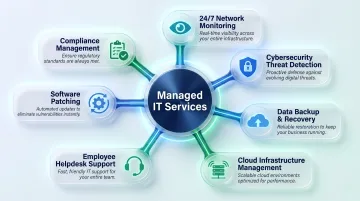
A full-service MSP typically handles:
- 24/7 network and endpoint monitoring — catching issues before they cause outages
- Cybersecurity threat detection — defending against ransomware, phishing, and unauthorized access
- Data backup and disaster recovery — ensuring business continuity if something does go wrong
- Cloud infrastructure management — keeping applications and servers running reliably
- Employee helpdesk support — resolving day-to-day tech issues quickly
- Software patching and updates — closing vulnerabilities before attackers can exploit them
- Compliance management — maintaining regulatory requirements on an ongoing basis
The Proactive Advantage
The core value of managed services is prevention, not just convenience. According to IBM's 2025 Cost of a Data Breach Report, the average data breach costs $4.44 million globally, with healthcare incidents averaging $7.42 million. The mean time to identify a breach is 181 days, with containment adding another 60 on top of that. Proactive monitoring exists specifically to shrink that window.
A good MSP doesn't wait for your server to go down before doing anything about it. They're watching your environment continuously, resolving issues most business owners never even find out about.
The Cost Structure
That proactive coverage also changes how you pay for IT. Rather than unpredictable invoices when something breaks, managed services run on a flat monthly fee. For small businesses, knowing what IT costs each month is far easier to plan around than absorbing a security incident or extended downtime out of pocket.
The Local Guy, based in South Salt Lake, is a Utah MSP that has operated this way for over 35 years. They provide 24/7 monitoring, layered cybersecurity, cloud management, and compliance support for dental practices and other regulated businesses — currently serving more than 100 companies across the state.
Who Benefits Most from Managed Services
Managed services fit best when there's no dedicated internal IT staff to handle the ongoing work. Typical clients include:
- Small accounting firms that need consistent security and compliance but can't justify a full-time hire
- Dental practices requiring ongoing HIPAA-compliant data management—not just initial setup
- Growing startups that need enterprise-level protection without enterprise-level headcount
IT Consultants vs. Managed IT Services: Which Is Right for Your Business?
Two questions cut through most of the confusion:
- Is this a one-time challenge with a defined endpoint, or an ongoing need requiring continuous attention?
- Do I have internal IT capacity to manage day-to-day operations, or does everything land on me?
Choose IT Consulting If:
- You're planning a specific project—cloud migration, new software rollout, office network buildout
- You need an independent expert opinion before a major technology investment
- You have an internal IT team that covers day-to-day work but lacks expertise in one specialized area
Choose Managed IT Services If:
- You have no dedicated IT staff
- You face recurring security risks or operate in a regulated industry (healthcare, dental, finance)
- You need consistent uptime and can't afford extended outages
- Ad-hoc IT support is costing more time and money than a predictable monthly contract
Consider Both If:
- You're starting with a major project (compliance audit, migration) and will need ongoing support after it wraps
- You want a single provider who can handle the initial strategy and maintain the environment long-term
Honest Cost Comparison
Consulting appears cheaper upfront. But without ongoing management, businesses absorb the full cost of downtime, security incidents, and reactive emergency fixes—none of which are cheap or predictable. IBM's data shows that only 35% of organizations reported full recovery from a breach by the time of the 2025 survey, with 76% of those recoveries taking more than 100 days.
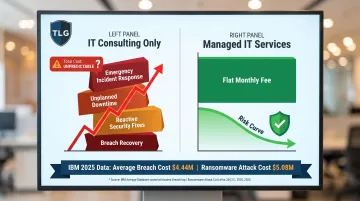
Managed services replace unpredictable IT expenses with a known monthly number—which is almost always lower than the cost of a single unplanned incident response.
Real-World Scenarios: Choosing the Right IT Support for Your Utah Business
Scenario A: The Dental Practice That Needed Both
A Utah dental practice decides to adopt new patient management software. Before going live, they bring in an IT consultant to audit their current compliance posture and design a HIPAA-compliant network architecture. The consultant identifies gaps, documents required safeguards, and oversees the new setup.
Once that project closes, the practice transitions to a managed IT services partner. The owner's realization was straightforward: HIPAA compliance isn't a one-time checkbox. It requires continuous documentation, monitoring, and policy enforcement.
With an MSP in place, the practice gains:
- No compliance gaps between audit cycles
- Predictable monthly IT costs
- Around-the-clock system monitoring
HHS Office for Civil Rights has resolved more than 150 cases involving civil money penalties and settlements totaling over $140 million. For dental practices, HIPAA enforcement is very real financial exposure—not a theoretical risk.
Scenario B: The Startup That Waited Too Long
A Utah startup grows from 5 to 25 employees over two years. IT is handled informally—whoever on the team is most tech-savvy fields issues as they come up. It works, until it doesn't.
A security incident (or a string of recurring downtime events) eventually forces the issue. Operations stall, client confidence takes a hit, and the cost of reactive emergency support far exceeds what a monthly managed services contract would have run.
After engaging an MSP for full coverage, the business gets proactive monitoring, consistent patch management, and a defined escalation path when something does go wrong. Reactive fixes can limit the damage after an incident, but they can't undo it. That distinction matters more than most startups expect—IBM's 2025 data puts the average cost of a ransomware or extortion incident at $5.08 million. Prevention is a business decision, not just a technical one.
If your Utah business is anywhere in this decision—evaluating options, recovering from an incident, or just realizing that informal IT support isn't scaling with you—The Local Guy offers free consultations to help assess whether IT consulting, managed services, or a combination of both fits where you are right now. Reach them at (801) 386-9491 or support@thelocalguy.com.
Frequently Asked Questions
What is the main difference between an IT consultant and managed IT services?
IT consulting is project-based and advisory—a specialist is engaged for a specific challenge with a defined endpoint. Managed IT services deliver continuous, proactive support covering day-to-day operations, security, and maintenance.
Can a small business use both IT consulting and managed IT services?
Yes—and many do. A common pattern is starting with consulting for a specific project (a compliance review, a migration) and then transitioning to managed services for continuous support. The Local Guy, for example, offers both under a single relationship—useful when you want continuity from the first conversation through long-term support.
Which is more cost-effective: an IT consultant or an MSP?
Managed services carry a predictable monthly fee that usually costs less than a single emergency response, extended downtime, or a security incident. Consulting has lower upfront costs but provides no ongoing protection—so the comparison depends on what risk your business can absorb.
Do managed IT service providers also offer IT consulting?
Most MSPs offer some form of consulting—particularly around technology strategy, infrastructure planning, and compliance readiness. This makes them a practical option for businesses that need both initial guidance and long-term support from one provider.
How do I know if my business needs managed IT services?
Key signals: no dedicated IT staff, frequent downtime, unresolved security concerns, operating in a regulated industry, or struggling to keep up with software updates and data backups alongside running the business.
Is managed IT worth it for businesses with fewer than 20 employees?
Small businesses are disproportionately targeted by cyber threats and often have the most to lose from a single incident. When the monthly cost of managed services is weighed against the cost of one serious breach or extended outage, the math usually favors proactive coverage—regardless of headcount.