The 2023 MCNA Dental breach exposed data belonging to roughly 8.9 million people — names, dates of birth, SSNs, and insurance details. It wasn't a fluke. Becker's Dental tracked at least 15 dentistry-impacting breaches and settlements in 2025 alone.
Most dental practice owners understand cybersecurity matters. Fewer understand what it actually does day-to-day — how it keeps systems running, prevents HIPAA penalties, and protects revenue when an attack occurs. This article explains the operational advantages of dental cybersecurity services in concrete terms, with a focus on what Utah practices should be doing right now.
Key Takeaways
- Dental practices hold high-value patient data with comparatively weaker defenses than large health systems — making them attractive targets
- Cybersecurity services cover three essentials: HIPAA compliance, ransomware prevention, and practice continuity
- A single breach without defenses in place can cost multiples of what proactive protection costs annually
- 67% of healthcare organizations reported a ransomware attack in the prior 12 months
- Cybersecurity works best as an ongoing program, not a one-time setup
What Is Dental Cybersecurity?
Dental cybersecurity is a coordinated set of tools, monitoring systems, and processes designed to protect a practice's data, networks, and clinical systems from unauthorized access, theft, or disruption.
It covers every technology a modern dental office depends on:
- Practice management software (scheduling, charting, billing)
- Patient records including digital X-rays and clinical notes
- Insurance and billing systems
- Staff email accounts — the most common attack entry point
- Remote access connections used by staff or IT vendors
Dental cybersecurity isn't a one-time installation — it's an ongoing operational program. Done right, it keeps your practice running, satisfies HIPAA compliance requirements, and protects the patient trust you've spent years building.
Key Advantages of Dental Cybersecurity Services
The advantages below connect directly to real operational and financial outcomes — risk, cost, compliance, and daily practice continuity — not abstract security theory.
Advantage 1: HIPAA Compliance Made Systematic
Dental practices that transmit electronic claims are HIPAA covered entities. That's not optional — it's a legal classification with specific, documented obligations under the Security Rule, including administrative, physical, and technical safeguards for protected health information (PHI).
The problem? Compliance is easy to believe you have and difficult to prove you have. A CDA survey of 214 small healthcare IT leaders and practice managers found 98% believed they were HIPAA compliant — despite serious documented gaps. Most of those gaps traced back to compliance programs built on assumption rather than documented evidence.
What cybersecurity services actually do for HIPAA compliance:
- Implement and document access controls so only authorized staff reach patient data
- Maintain audit logs that show who accessed what and when
- Ensure data is encrypted in storage and during transmission
- Support business associate agreement (BAA) management for third-party vendors
- Provide formal incident response documentation if something goes wrong
Non-compliance penalties range from hundreds to tens of thousands of dollars per violation — and enforcement is active. OCR imposed a $70,000 civil monetary penalty against a solo dental practice for access control failures, and has announced multiple ransomware-related HIPAA Security Rule settlements in 2025–2026.
When this matters most: During practice growth (adding staff, locations, or systems), when onboarding new cloud tools or vendors, or any time OCR investigation or insurance claims require documented evidence of compliance.
Advantage 2: Proactive Ransomware and Data Breach Prevention
Ransomware — malware that locks all systems and demands payment to restore access — is now the dominant threat facing dental offices. The entry point is almost always an email.
According to Sophos's 2024 healthcare survey, 67% of healthcare organizations reported a ransomware attack in the prior 12 months, with a median recovery cost of $750,000. IBM's analysis puts the average healthcare data breach cost at $10.93 million — the highest of any industry.
The mechanics matter here. Most damaging incidents don't detonate immediately. Attackers typically:
- Enter through a phishing email or stolen credential
- Move quietly through the network, escalating privileges
- Map systems and locate backups
- Disable recovery options
- Trigger ransomware when they're ready
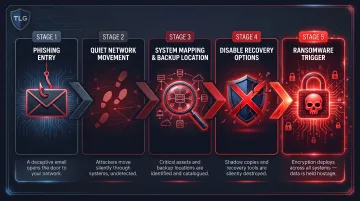
Early detection at any stage of that sequence limits how far damage spreads. That's the operational value of layered defenses — catching threats before they reach step 5.
What a cybersecurity program uses to prevent breaches:
- Continuous threat monitoring to detect anomalous behavior as it happens
- Endpoint detection and response (EDR) on every device
- Email security and DNS filtering to block malicious links before staff click them
- Multi-factor authentication (MFA) to prevent credential theft from becoming account takeover
- Phishing simulation training — a multicenter study in JAMA Network Open found a 14.2% average click rate on simulated phishing emails in healthcare, dropping significantly after repeated training
The Local Guy's Total Cybersecurity service is built around this layered model, combining 24/7 monitoring with controls at every entry point where dental practices are most exposed.
When this matters most: High-volume email workflows (billing, insurance), periods of staff turnover when new employees are most vulnerable, and practices processing frequent insurance transactions.
Advantage 3: Practice Continuity and Revenue Protection
Modern dental practices run entirely on technology. Practice management software, digital imaging, scheduling, ePrescribing, and billing systems operate every hour of the clinical day. When any of those go down, production stops.
The revenue math is straightforward: daily production loss × days offline = direct downtime cost. That calculation doesn't include forensic investigation fees, regulatory notification costs, or the long-term patient attrition that follows a public breach.
What cybersecurity services protect against downtime:
- Encrypted off-site backups with tested restoration procedures
- Network segmentation to contain lateral movement if an attacker gets in
- Rapid incident response capabilities with clear escalation paths
- Recovery plans designed to get systems back online in hours, not days
The difference between a tested backup and an untested one only surfaces under pressure. Practices that run regular restoration drills know exactly how long recovery takes. Those that skip the drills typically find out during a ransomware event, when days offline — not hours — becomes the reality.
KPIs this protects:
- System uptime and availability
- Recovery time objective (RTO)
- Daily production recovery speed
- Insurance claim processing continuity
When this matters most: Multi-operatory practices where a full system outage affects every chair simultaneously, high-volume appointment offices, and any practice running a fully paperless workflow.
What Happens When Dental Cybersecurity Is Ignored
Reactive cybersecurity — responding after an incident rather than preventing one — consistently costs more and damages more than proactive protection ever would.
Common consequences practices face without active defenses:
- Ransomware lockouts that cancel appointments, trigger ransom decisions under pressure, and wipe out days of production
- Mandatory breach notifications, OCR investigations, and HIPAA fines — even when the practice believed it had nothing to worry about
- Phishing compromises that go undetected for weeks, giving attackers time to escalate access and disable backups before striking
- Escalating remediation costs driven by unpatched software, aging hardware, and undocumented access controls
- Reputational damage in local communities where word travels fast — patients whose data is exposed rarely stay quiet
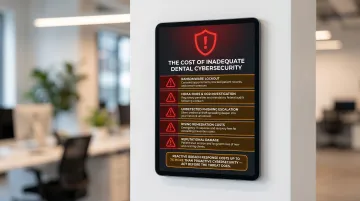
That third bullet — the breach notification — carries legal weight beyond the immediate fallout. Under HIPAA's Breach Notification Rule, practices must notify affected individuals within 60 days of discovery. Breaches affecting 500 or more state residents trigger additional media notification requirements and heightened OCR scrutiny.
How to Get the Most Value from Dental Cybersecurity Services
Dental cybersecurity delivers its best ROI as an ongoing operational program, not a tool you configure once. Three conditions determine how much value a practice actually gets:
1. Consistent, complete coverage All systems must be covered — clinical imaging, billing, remote access, and every staff device. Partial coverage creates gaps that attackers are looking for. Policies should be revisited whenever new technology or personnel are added.
2. Regular outcomes reviews Security posture reviews, HIPAA risk assessments, and backup restoration tests need to be scheduled and repeated — not treated as a one-time setup activity. What passed last year may not pass today.
3. A provider who understands dental IT specifically Generalist IT support frequently misses the nuances of dental practice management software, HIPAA documentation requirements, and the clinical workflows that make dental environments unique. A provider with dental-specific experience — like The Local Guy, which has served Utah dental practices for over 35 years — covers both the technical and regulatory dimensions without forcing you to coordinate between multiple vendors.
Conclusion
Dental cybersecurity isn't a luxury or a future consideration. It's a core operational requirement for any practice handling sensitive patient data and running on integrated digital systems.
Compliance protection, breach prevention, and practice continuity all compound in value when applied consistently. A practice that maintains proactive security builds documentation, institutional knowledge, and resilience over time.
By contrast, a practice caught without defenses during an incident faces forensic recovery costs, HIPAA penalties, and reputational damage that routinely runs several times the cost of ongoing protection.
Cybersecurity requires continuous attention, not a one-time setup. Work with a provider who understands both the underlying technology and the specific HIPAA requirements your dental office operates under — one with direct experience supporting dental practices, not just general IT clients.
Frequently Asked Questions
Do dental offices have to be HIPAA compliant?
Yes. Dental offices that transmit electronic covered transactions — such as electronic insurance claims — are classified as HIPAA covered entities and must implement specific technical, administrative, and physical safeguards for protected health information. Non-compliance carries real consequences: civil monetary penalties, mandatory corrective action plans, and OCR investigations.
Which is a common cybersecurity risk for dental offices?
Phishing emails and ransomware are the most common and damaging threats. Attackers typically enter through deceptive emails targeting staff, then escalate access to lock systems or extract patient data often before the practice detects the breach.
Why is cybersecurity important for dental practices?
Dental practices store high-value personal, medical, and financial data while typically lacking the robust IT defenses of larger healthcare systems — making them attractive targets. A breach can cause significant downtime, direct revenue loss, HIPAA penalties, mandatory patient notifications, and lasting damage to patient trust.
What are the four types of IT security?
The four main categories are network security (protecting office network traffic), endpoint security (protecting staff workstations and laptops), application security (protecting practice management and billing software), and data security (protecting stored and transmitted patient records). Each targets a distinct attack surface in a dental environment.
What are the 5 C's of cybersecurity?
The 5 C's are Change (adapting to new threats), Compliance (meeting HIPAA requirements), Cost (balancing security investment against risk), Continuity (keeping clinical operations running during incidents), and Coverage (ensuring no system or device is left unprotected). Together, they form a practical security checklist for dental practices.