This guide covers what IT consultants actually do for small businesses, which services matter most, what you should expect to pay, and how to find a partner worth trusting — not just a vendor who shows up when things break.
Key Takeaways
- IT consulting shifts technology from a reactive headache to a strategic advantage
- Core services — cybersecurity, cloud solutions, network management, and IT planning — directly protect revenue and reduce risk
- Outsourcing to a managed service provider costs a fraction of hiring even one full-time IT employee
- The right consulting partner acts as your external IT department — proactive monitoring, not emergency firefighting
- Choose a partner with local experience, industry-specific expertise, and a commitment to ongoing support
What Does a Small Business IT Consultant Do?
Most people think of IT support as someone who fixes things when they break. A real IT consultant does something different: they help you use technology to actually run a better business.
That means assessing your current systems, identifying what's holding you back, and building a roadmap where every technology decision ties to a specific business outcome. Think: scaling from 10 to 50 employees, opening a second location, or eliminating the daily tech friction that costs your team hours each week.
The Break-Fix vs. Consulting Distinction
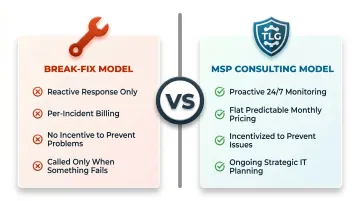
The difference between a break-fix vendor and a true IT consulting partner is the difference between a mechanic you call when your car won't start and a fleet manager who keeps your vehicles maintained so breakdowns rarely happen.
Break-fix models charge per incident, respond reactively, and have no financial incentive to prevent problems. A consulting mindset — especially through a Managed Service Provider (MSP) — shifts that dynamic entirely. Proactive monitoring, strategic planning, and ongoing maintenance replace the cycle of reactive calls and repair invoices.
Delivery Models Small Businesses Can Choose From
| Model | What It Looks Like | Best For |
|---|---|---|
| Independent consultant | Solo practitioner, project or hourly basis | Specific one-time projects |
| Boutique IT firm | Small team, broader expertise | Growing businesses needing variety |
| Software vendor | Focused on their own product | Single-platform implementations |
| Managed Service Provider (MSP) | Bundled ongoing support, monitoring, security, strategy | Most small businesses |
For most small businesses, an MSP offers the most practical fit. Help desk support, cybersecurity monitoring, and strategic guidance come bundled into one relationship — without hiring a CIO, systems engineer, and network administrator separately.
The Local Guy, based in South Salt Lake, operates exactly this way. Rather than positioning as a tech vendor, they describe their service as acting like your own internal IT department — monitoring systems around the clock and handling maintenance behind the scenes before small problems compound into costly outages.
Core IT Services Small Businesses Actually Need
Cybersecurity
Small businesses aren't too small to be targeted — they're targeted because they're easier. According to the U.S. Small Business Administration, 41% of small businesses were victims of a cyberattack in 2023, with a median cost of $8,300 per incident. The Verizon 2025 DBIR found that ransomware appeared in 88% of small business breaches — more than double the rate seen at large organizations.
A competent IT consultant builds layered defenses, typically including:
- Endpoint detection and response (EDR) across every device
- Multi-factor authentication (MFA) on all critical systems
- Email filtering and phishing protection
- 24/7 threat monitoring and managed detection and response (MDR)
- Custom security plans aligned to your industry's compliance requirements
Strategic IT Planning
Many small businesses fall into a pattern of reactive spending — upgrading hardware when it fails, buying software when a problem gets loud enough. A consultant breaks that cycle by creating a technology roadmap that ties each investment to a specific business goal.
That roadmap does three things: it helps you budget predictably, cuts redundant tools you're already paying for, and surfaces improvements that actually move revenue or reduce risk — rather than just keeping the lights on.
Cloud Computing
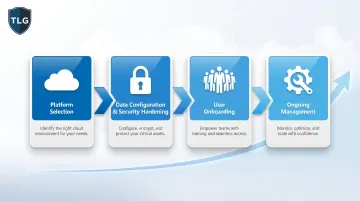
Cloud migration delivers more than reduced server costs. Done right, it gives your team remote access, better collaboration tools, built-in disaster recovery, and room to scale without buying new hardware. A consultant manages the full transition, covering:
- Platform selection matched to your actual workflow
- Data configuration and security hardening during the move
- User onboarding so productivity doesn't stall post-migration
- Ongoing management once you're live
The Local Guy focuses primarily on Microsoft 365 migrations, handling the full setup including Teams and SharePoint so teams can work productively from anywhere — while keeping security built in from the start, not added as an afterthought.
Network and Infrastructure Management
Network reliability, server maintenance, and data backup aren't glamorous, but they're foundational. Research from Forrester found that 41% of organizations experienced unexpected downtime every week or month. For a small business, even a few hours of downtime can mean lost sales, missed deadlines, and damaged client relationships.
Proactive infrastructure management catches problems before they cascade — failed backups, aging hardware, network vulnerabilities — rather than discovering them during a crisis.
Compliance Support
Regulated industries carry a layer of IT obligation that most small business owners underestimate. For healthcare and dental practices, HIPAA violations carry civil penalties ranging from $145 to over $2 million per violation depending on culpability — and HHS OCR has specifically fined dental practices for compliance failures.
IT consultants help regulated businesses implement the access controls, audit logging, and secure network design required to meet these standards. When evaluating a consultant for a regulated industry, look for demonstrated experience in your specific compliance framework — not just general IT knowledge. The Local Guy, for instance, has built specialized expertise in dental IT compliance, including HIPAA-aligned network design for practices across Utah.
Key Benefits of IT Consulting for Small Businesses
Cost Efficiency vs. In-House Hiring
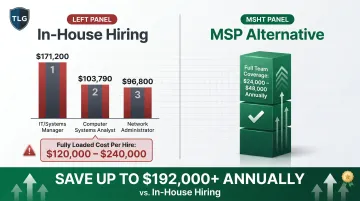
The salary math alone makes a compelling case for outsourcing. According to BLS May 2024 data:
- IT/Systems Manager (CIO proxy): $171,200 median annual salary
- Computer Systems Analyst: $103,790 median
- Network Administrator: $96,800 median
Add benefits, payroll taxes, and overhead (typically 1.25–1.4x salary), and a single IT hire costs $120,000–$240,000 fully loaded. A 25-person company can typically contract a full-service MSP for $2,000–$4,000 per month — roughly $24,000–$48,000 annually for a team of specialists rather than one generalist.
Security Without a Full-Time CISO
The median total compensation for a Chief Information Security Officer is $324,057 per year (Glassdoor, 2025). Fewer than 5% of small businesses have a dedicated security officer on staff. That's not a gap most small businesses can close with a full-time hire.
MSPs fill this gap by providing CISO-level security strategy, threat monitoring, and incident response at a cost that fits smaller budgets. The Local Guy's security team monitors client systems 24/7 and builds custom security plans, providing the outcomes of dedicated security leadership at a fraction of the executive cost.
Scalability
Good IT infrastructure is designed to grow with your business. A consultant builds systems that handle new users, additional locations, or higher data volumes without rebuilding from scratch each time.
A business opening a second location, for example, needs to have these pieces in place before the expansion starts:
- Centralized data access across both sites
- Secure remote connectivity for staff
- Consistent device management and policy enforcement
Reduced Downtime and Better Productivity
Shifting from break-fix support (reactive repairs after something fails) to proactive monitoring means fewer disruptions. Systems stay current, backups are validated, and vulnerabilities get patched before they become incidents. Over time, that shift adds up: teams that spend less time troubleshooting recover hours each week that go directly back into productive work.
Signs Your Small Business Is Ready for IT Consulting
Only 25% of small businesses have employees dedicated to IT support — meaning most owners are handling technology decisions on top of everything else. Here are the clearest signals that outside expertise would help:
Operational warning signs:
- Manual, clunky workflows that haven't improved in years
- Systems that don't communicate with each other (data re-entered in multiple places)
- Staff spending significant time troubleshooting instead of working
- Previous downtime, data loss, or a slow response to a security issue
Growth often creates its own set of pressures. Watch for these inflection points:
Growth-trigger moments:
- Planning a significant hire or physical expansion
- Launching a new service line or client-facing product
- Needing to meet a compliance requirement for the first time
- Moving to remote or hybrid work
The "we're too small" hesitation is worth addressing directly: there's no minimum business size at which IT consulting delivers ROI.
Waiting until something goes wrong is almost always more expensive than addressing it before problems surface — whether that's a ransomware incident, a failed backup during a hardware failure, or a compliance audit revealing years of unaddressed gaps.

How to Choose the Right IT Consulting Partner
Start with your own inventory. Before evaluating firms, document what you're working with: network setup, software tools, cloud services, devices, and any compliance obligations. Knowing what problems you're trying to solve determines what expertise actually matters.
What to evaluate in any firm:
- Responsiveness — Do they respond in hours or days? Local presence helps.
- Industry experience — Have they worked with businesses like yours, including any compliance requirements your industry carries?
- Service breadth — Do they cover cybersecurity, cloud, and compliance under one roof, or will you be patching together multiple vendors?
- Ongoing vs. project-only — continuous support means a partner who knows your systems before something breaks.
- References — Ask for examples from similar businesses. Check Google reviews.
Questions worth asking before signing:
- Can you walk me through a project similar to what we need?
- What does your onboarding process look like?
- How do you handle security incidents — what's the response process?
- What does ongoing support include after implementation?
Those last two questions matter most. A firm that can't clearly explain what "ongoing support" covers after the contract is signed will likely leave you calling around at 9 PM with no one to answer. For Utah businesses, The Local Guy checks those boxes specifically: 35+ years of local experience, 24/7 monitoring, and specialized dental IT compliance work — the kind of depth that generic MSPs rarely offer.
How Much Does Small Business IT Consulting Cost?
Pricing Models
| Model | Typical Range | Best For |
|---|---|---|
| Hourly consulting | $150–$250/hour | One-time projects, audits |
| Per-user/month (MSP) | $70–$150/user/month | Ongoing managed services |
| Flat monthly retainer | $1,000–$5,000/month | Small businesses wanting predictable costs |
| Project-based | Varies by scope | Migrations, implementations |
Source: MSPAA, 2025. Healthcare/dental organizations often pay a 20–30% premium due to compliance complexity.
Is $100/Hour Reasonable?
At the current market rate of $150–$250/hour for comprehensive IT consulting, $100/hour falls at or below the market floor. That rate is more consistent with break-fix support from a solo technician than full-service MSP-level consulting. If a firm quotes $100/hour for ongoing managed services, clarify what's actually included — it likely won't cover proactive monitoring, security, or strategic guidance.
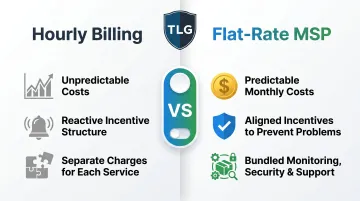
For most small businesses with ongoing IT needs, flat-rate MSP pricing is a better value than hourly billing. Here's why it tends to win out:
- Predictable costs — no surprise invoices when something breaks
- Aligned incentives — providers profit by preventing problems, not fixing them
- Bundled coverage — monitoring, security, and support that hourly models bill separately
Framing It as an Investment
A single ransomware incident costs small businesses a median of $8,300 — before factoring in downtime and recovery costs. One day of operational downtime for a 20-person company can easily exceed a month's MSP fees. Against those numbers, IT consulting isn't a cost to minimize. It's how you avoid much larger ones.
Frequently Asked Questions
What does a small business IT consultant do?
An IT consultant helps businesses use technology strategically — building security infrastructure, managing networks, solving day-to-day issues, and creating technology roadmaps tied to business goals. A strong IT consultant acts as an external IT department, not just a repair service.
What IT services do small businesses need most?
The essentials are cybersecurity protection, cloud solutions, network management, data backup and disaster recovery, and strategic IT planning. Which ones to prioritize depends on your industry, growth stage, and any compliance requirements you're subject to.
How much does small business IT consulting cost?
Expect $70–$150 per user per month for managed services, $1,000–$5,000/month for flat retainers, or $150–$250/hour for project-based consulting. Healthcare and regulated industries typically pay more due to compliance overhead.
Is $100/hour good for small business IT consulting?
It's below the current market rate for comprehensive managed IT services ($150–$250/hour). At $100/hour, you're likely getting break-fix support, not strategic consulting. For ongoing needs, flat-rate MSP pricing usually delivers better value.
Should I hire in-house IT staff or use a consulting firm?
In-house staff offers dedicated attention, but fully loaded costs run $100,000–$240,000+ per employee — and one person can't cover cybersecurity, cloud, compliance, and infrastructure. An MSP or consulting firm gives you a team of specialists for a fraction of that cost, and scales with you.
How do I know if my small business needs IT consulting?
Common signals include:
- Frequent downtime or slow systems
- Staff spending time troubleshooting instead of working
- Manual or disconnected workflows
- Upcoming growth, new hires, or office expansion
- New compliance requirements or unresolved security concerns
If any of these apply, the cost of consulting is lower than the cost of going without it.