For small and mid-sized practices in Utah, the technology partner you choose isn't just a vendor. Under HIPAA, they're a legally accountable party. Healthcare data breaches cost an average of $10.93 million in 2023—the highest of any industry—yet many practices still work with IT providers who have never signed a Business Associate Agreement or conducted a formal risk assessment.
This guide covers what HIPAA actually requires from your MSP, how the law classifies your IT provider, what technical safeguards must be in place, and how to evaluate whether your current provider is genuinely protecting you—or quietly leaving you exposed.
Key Takeaways
- MSPs handling patient data are legally classified as Business Associates under HIPAA and face the same penalties as covered healthcare providers
- A signed Business Associate Agreement (BAA) is mandatory; operating without one puts both parties at enforcement risk
- HIPAA compliance requires three safeguard categories: administrative, physical, and technical
- Healthcare breaches now average $10.93 million, and the human element is involved in 68% of incidents
- Dental practices are fully covered entities under HIPAA—no exceptions
What HIPAA Is and Why It Applies to Your IT Provider
HIPAA—the Health Insurance Portability and Accountability Act—was enacted in 1996 to protect patient privacy and ensure health data could move securely between providers and insurers. Over time, the law expanded well beyond its original scope. The Security Rule (compliance required by April 20, 2005 for most entities) established specific technical, physical, and administrative requirements for protecting electronic data.
Protected Health Information (PHI) includes any individually identifiable health information: names, dates of birth, Social Security numbers, diagnoses, treatment records, and billing history.
When that information exists in electronic form—stored on a server, transmitted via email, or processed through practice management software—it becomes electronic PHI (ePHI).
HIPAA applies to three categories of organizations:
- Covered entities: healthcare providers, health plans, and healthcare clearinghouses
- Business associates: vendors or service providers who create, receive, maintain, or transmit PHI on behalf of a covered entity
- Subcontractors of business associates: vendors hired by a business associate whose work also involves PHI
Dental practices are healthcare providers under HIPAA. A Utah dental office that submits electronic insurance claims, stores patient X-rays digitally, or uses cloud-based practice management software is a covered entity — and all three HIPAA categories likely apply somewhere in its technology stack.
How MSPs Are Classified Under HIPAA: The Business Associate Role
The Business Associate Definition
Under HIPAA, a Business Associate (BA) is any person or organization that performs services for a covered entity involving the use or disclosure of PHI. An MSP that manages your network, maintains your servers, administers your email, or handles your backups qualifies—even if no one at that company ever reads a patient record. Access to systems that contain ePHI is enough.
The subcontractor liability piece catches many providers off guard. If your MSP uses a third-party cloud vendor to host your backups, that vendor also becomes a Business Associate of a Business Associate—and is still bound by HIPAA. This chain of liability is routinely overlooked in smaller markets, particularly among practices that assume their MSP handles everything downstream.
The Business Associate Agreement (BAA)
A BAA is a legally required contract that must be in place before an MSP touches any system containing ePHI. It establishes:
- What the MSP is permitted to do with PHI
- The MSP's obligation to implement HIPAA safeguards
- Requirements to report breaches to the covered entity
- The MSP's responsibility to flow those obligations down to any subcontractors
Without a signed BAA, both the practice and the MSP are exposed to federal enforcement action. The HHS sample BAA provisions offer a useful baseline for evaluating whether your MSP's contract terms are adequate.
Penalty Exposure
A BAA defines responsibility — but it doesn't eliminate liability if that responsibility goes unmet. The Omnibus Rule of 2013 extended direct HIPAA enforcement to Business Associates and their subcontractors, meaning your MSP can be penalized independently by HHS, separate from any action taken against your practice.
Civil penalties are tiered by culpability:
| Tier | Culpability | Per-Violation Range | Annual Cap |
|---|---|---|---|
| 1 | Unknowing | $100–$50,000 | $25,000 |
| 2 | Reasonable cause | $1,000–$50,000 | $100,000 |
| 3 | Willful neglect, corrected | $10,000–$50,000 | $250,000 |
| 4 | Willful neglect, uncorrected | $50,000 (max) | $1,500,000 |
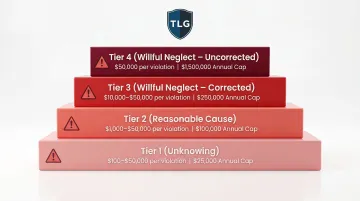
Criminal penalties apply when PHI is knowingly obtained or disclosed: up to $50,000 and one year imprisonment, escalating to $250,000 and ten years when done for commercial gain or malicious harm.
In March 2026, HHS settled a HIPAA case against MMG Fusion, LLC—a software company serving dental practices—as part of its Risk Analysis Initiative. The settlement confirms that HHS is actively pursuing Business Associates, not just covered entities — making a completed, documented risk analysis a non-negotiable baseline for any MSP supporting healthcare clients.
The Three HIPAA Safeguards MSPs Must Deliver
The HIPAA Security Rule organizes its requirements into three safeguard categories under 45 CFR 164.308, 164.310, and 164.312. A compliant MSP must demonstrate implementation across all three.
Administrative Safeguards
Administrative safeguards are process and policy controls — not technology. Think of them as the governance layer that makes everything else defensible during an audit.
Required components include:
- Security Risk Assessments (SRAs): A formal analysis of risks to ePHI confidentiality, integrity, and availability. HHS and ONC provide a free Security Risk Assessment Tool designed for small and medium practices.
- Written security policies covering access management, incident response, workforce conduct, and contingency planning
- Role-appropriate workforce training, with completion records maintained
- A named individual accountable for HIPAA compliance (a designated security officer)
- Documented backup, disaster recovery, and emergency mode operation plans — tested regularly
Most small dental and medical practices don't have a dedicated compliance officer. A qualified MSP fills that gap by building and maintaining the administrative framework, not just the technology. That distinction matters when OCR comes knocking.
Physical Safeguards
Physical safeguards govern how access to ePHI is controlled in the real world — not just on servers, but in the spaces where people work.
Core requirements:
- Facility access controls restricting entry to server rooms, data centers, and anywhere ePHI is stored or processed
- Workstation policies governing how and where staff access patient data, with physical measures to prevent unauthorized use
- Device and media controls: encryption on laptops and mobile devices, and secure disposal of hard drives when equipment is retired
Remote work adds a layer most practices overlook. Staff accessing ePHI from home must do so in environments where household members cannot view patient data. That requires explicit written policy — not a general expectation that employees will sort it out themselves.
This is where physical and administrative safeguards overlap. The policy lives in the administrative category; the enforcement depends on physical controls.
Technical Safeguards
Technical safeguards are the system-level controls that prevent unauthorized access or alteration of ePHI. Four categories are required:
| Control | What It Does |
|---|---|
| Access controls | Role-based permissions, unique user IDs, automatic logoff after inactivity |
| Audit controls | Logs who accesses ePHI, when, and from where — enabling anomaly detection |
| Integrity controls | Mechanisms ensuring ePHI isn't altered or destroyed without authorization |
| Transmission security | Encryption of ePHI in transit, typically via TLS protocols |
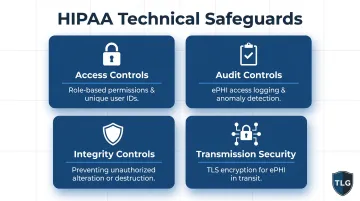
Multi-factor authentication (MFA) is not yet explicitly mandated under the current Security Rule, but HHS proposed in a December 2024 NPRM to require MFA and encryption of ePHI at rest and in transit. Auditors increasingly expect it regardless, and any MSP not deploying MFA across healthcare environments is taking a position that will become harder to defend.
What HIPAA-Compliant Managed IT Services Actually Include
Continuous Monitoring and Patch Management
Compliance isn't an annual checkbox. A qualified MSP delivers:
- 24/7 network and endpoint monitoring to detect anomalies and unauthorized access attempts in real time
- Patch management that closes known vulnerabilities before they're exploited—Northeast Radiology settled with HHS for $350,000 after a breach linked to an inadequately secured PACS server and failure to conduct a thorough risk analysis
- Audit log review maintaining continuous visibility into ePHI access across all systems
Encrypted Backup and Disaster Recovery
Under 45 CFR 164.308(a)(7), covered entities must maintain a data backup plan, a disaster recovery plan, and an emergency mode operation plan. For a dental or medical practice, unplanned downtime doesn't just cost money—it disrupts patient care.
A compliant MSP manages:
- Encrypted backups stored offsite, in the cloud, or both
- Regular recovery tests with documented results
- Defined recovery time objectives so the practice knows how quickly systems can be restored
Cybersecurity Protections Specific to Healthcare
The human element is involved in 68% of data breaches, according to Verizon's 2024 Data Breach Investigations Report—making staff behavior the single biggest security risk in any practice. A HIPAA-compliant MSP addresses this through layered protections:
- Endpoint detection and response (EDR) covering every workstation and server
- Email filtering and phishing protection to catch malicious messages before staff see them
- Security awareness training with simulated phishing exercises tailored to practice staff roles
- Dark web monitoring to detect if staff credentials have been compromised
Staff Training and Compliance Documentation
HIPAA requires documented evidence of workforce training—not just the training itself. A compliant MSP helps practices roll out role-appropriate training programs, track completion, and maintain records of security policies, risk assessments, and incident response activities.
This matters most for small Utah dental and medical practices without a dedicated compliance officer. When an audit occurs, documentation needs to already exist and be organized—not assembled under pressure.

That's where a local MSP with healthcare-specific experience makes a practical difference. The Local Guy has worked with Utah dental and medical practices for over 35 years, helping them maintain the documentation, monitoring, and security controls that HIPAA requires year-round.
The Real Cost of HIPAA Non-Compliance
Financial Penalties
The tiered penalty structure outlined earlier means even an "unknowing" violation can cost up to $25,000 per year for identical violations. Willful neglect that goes uncorrected carries an annual cap of $1.5 million—and that's before factoring in legal costs, forensic investigation, and remediation.
A single breach affecting thousands of patients can produce multi-million dollar settlements. The reputational damage compounds the financial hit: patients who lose trust in how their health information is handled don't come back, and word spreads quickly in smaller Utah communities.
Breach Notification Requirements
Under the Breach Notification Rule, covered entities must:
- Notify affected individuals without unreasonable delay and within 60 days of discovery
- Notify HHS within the same 60-day window (or by the end of the calendar year for breaches affecting fewer than 500 individuals)
- Notify prominent media outlets if the breach affects 500 or more residents of a state
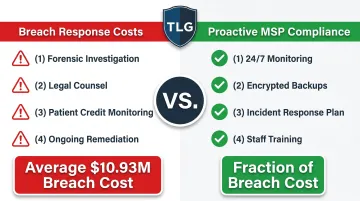
Meeting those requirements carries its own steep price tag. Breach response costs typically include:
- Forensic investigation to identify the scope of exposure
- Legal counsel to navigate notification obligations
- Credit monitoring services for affected patients
- Ongoing remediation to close the vulnerability
A well-structured MSP relationship—with tested backups, documented incident response procedures, and active monitoring—costs far less than managing a breach after the fact.
How to Choose a HIPAA-Compliant MSP in Utah
What to Evaluate
Not every IT provider has the healthcare-specific knowledge HIPAA requires. Generic MSPs can unintentionally create compliance exposure simply by applying standard IT practices to healthcare environments. When evaluating an MSP, look for:
- Documented healthcare IT experience: Ask for specific examples of dental, medical, or other healthcare clients they actively serve
- Willingness to sign a BAA: This is non-negotiable. If they hesitate or don't know what a BAA is, that's your answer
- Demonstrated security capabilities: Not general IT support, but specific controls—MFA, EDR, audit logging, encrypted backups
- Formal Security Risk Assessment as part of onboarding: A compliant MSP should conduct or facilitate an SRA before finalizing your security posture
Questions to Ask Prospective MSPs
Before signing with any IT provider, ask directly:
- Do you have specific experience with dental or medical practices?
- Can you provide and sign a Business Associate Agreement?
- How do you handle breach notification if an incident occurs?
- What documentation do you maintain, and can we access it?
- Do you provide staff security awareness training?
- How do you stay current with HIPAA regulatory changes?
A qualified MSP answers these questions confidently, with specific examples. Vague answers about "industry-standard security" are a red flag.
For Utah healthcare and dental practices, a local MSP offers real advantages beyond technical capability: faster on-site response, familiarity with the regional market, and a team you can reach by phone rather than a ticketing queue.
The Local Guy, based in South Salt Lake, brings over 35 years of Utah IT experience to dental and healthcare practices—covering cybersecurity, 24/7 monitoring, BAA support, and HIPAA compliance infrastructure. Call (801) 386-9491 to discuss your practice's specific needs.
Frequently Asked Questions
Who must comply with HIPAA?
HIPAA applies to covered entities—healthcare providers, health plans, and clearinghouses—and their business associates, meaning any vendor or service provider that creates, receives, maintains, or transmits PHI on their behalf. Subcontractors of business associates are also bound. MSPs managing healthcare IT systems fall squarely within this scope.
What are the 5 main HIPAA rules?
The five rules are:
- Privacy Rule — governs use and disclosure of PHI
- Security Rule — administrative, physical, and technical safeguards for ePHI
- Breach Notification Rule — reporting requirements after a breach
- Enforcement Rule — penalties and investigation procedures
- Omnibus Rule — extends direct liability to business associates and subcontractors
Which is stricter: HIPAA or 42 CFR Part 2?
42 CFR Part 2 is stricter. It governs confidentiality of substance use disorder treatment records and imposes tighter restrictions on re-disclosure than HIPAA. Organizations handling both types of data must comply with both sets of rules simultaneously.
What is a BAA and why does my MSP need to sign one?
A Business Associate Agreement is a legally required HIPAA contract that defines what the MSP may do with PHI, requires appropriate safeguards, and establishes breach reporting obligations. Without a signed BAA, both the healthcare organization and the MSP face federal enforcement action.
Do dental practices need to be HIPAA compliant?
Yes. Dental practices are classified as healthcare providers under HIPAA and must comply with all applicable rules—covering patient records, X-rays, treatment histories, and billing data. Any MSP serving a dental practice must be HIPAA compliant as a business associate.
What happens if my MSP causes a HIPAA breach?
Under the Omnibus Rule, MSPs are directly liable for breaches they cause or contribute to—HHS can penalize them independently of the covered entity. The covered entity still bears its own breach notification obligations, making MSP security failures a shared legal and financial problem for both parties.